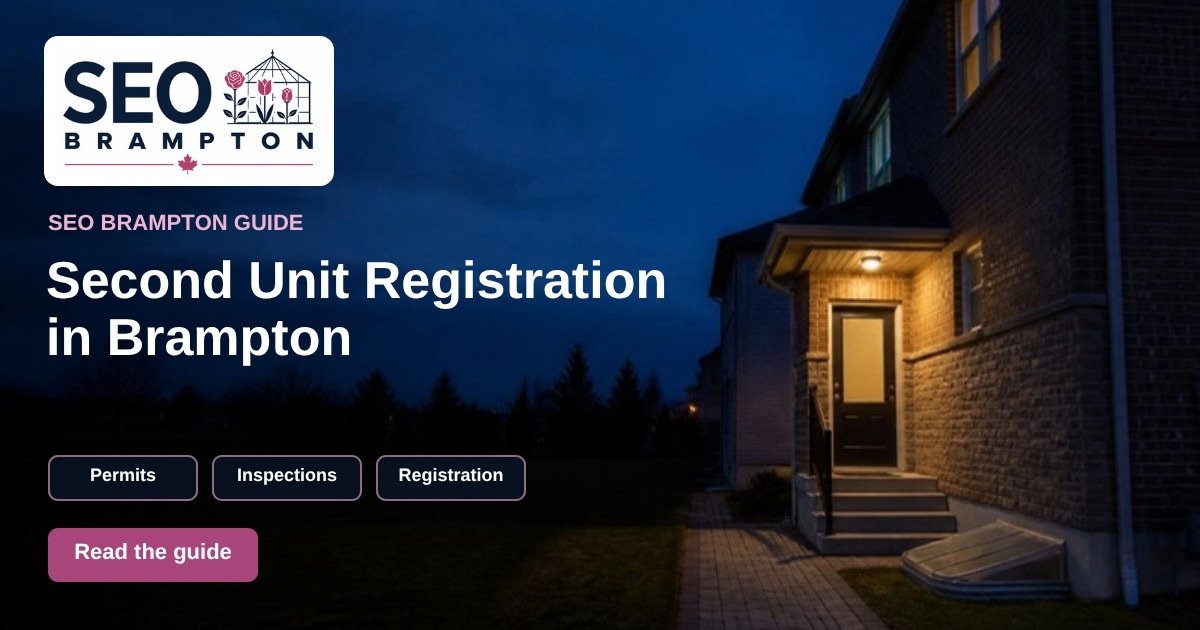
Before a Brampton, Ontario homeowner calls a contractor about a basement apartment, they usually spend an evening reading about the rules. Google’s suggestions show the questions in the order people ask them: “brampton second unit registration”, “brampton second unit requirements”, “brampton two unit dwelling”, “brampton basement permit”, “brampton basement permit status”, “brampton basement inspection booking”. Only after that do searches like “brampton basement renovations” appear. This guide is for contractors, designers and renovators who build second units: how to be the business that answers those questions, so that you are the one they call when they are ready.
Why second unit registration comes first in the search
In Brampton, a second unit has to be registered with the City to be legal. The City began registering two-unit dwellings on 22 June 2015, and it now publishes registered two- and three-unit dwellings and garden suites on an interactive map. Homeowners know there is a process, and many have heard stories of a basement built without a permit that later had to be redone. So they start with the City’s process, not with a builder.
That gives a contractor an opening. The homeowner is not yet comparing quotes. They are trying to understand what a legal unit involves. A business whose website explains that clearly earns trust before the first phone call.
What homeowners are trying to find out
Looking across the suggestions, the questions fall into a few groups:
- Is my house suitable? “brampton second unit requirements”, “brampton secondary unit”, “brampton two unit dwelling”.
- What does the City need from me? “brampton second unit registration”, “brampton basement permit”, “brampton basement rental license”.
- Where is my application? “brampton basement permit status”, “brampton basement inspection booking”, “brampton second unit registry”.
- Has anything changed? “brampton basement new rules”.
Each group is a page, or a clear section of a page, on a contractor’s website.
Explain the process without pretending to be the City
The most useful page you can publish is a plain walk-through of how a second unit project runs with your firm: the first site visit, drawings, the permit application, construction, inspections and registration. Say which steps you handle and which the homeowner handles. Say roughly how long each stage has taken on your recent jobs, and be honest that the City’s timelines are outside your control.
What you should not do is copy the City’s requirements onto your page as if they were fixed. Rules, fees and forms change. Describe the kinds of things the City looks at, then link to the City of Brampton’s current second unit pages and tell readers to check the latest requirements there. A page that sends people to the official source is more trustworthy, and it will not go out of date the next time a by-law is updated.
Show the work that makes a unit legal
Homeowners want to see that you understand what goes into a compliant unit, not just a nice finish. Photos and short notes on your own projects help here:
- A separate side entrance, with the steps and landing you built.
- Egress windows and window wells.
- Fire separation and smoke alarm work, described in plain words.
- Heating, ventilation and plumbing for the new unit.
- Electrical work by a licensed electrical contractor, with an Electrical Safety Authority permit where one is required.
Use your own photos from Brampton jobs, with the homeowner’s permission, and describe each one accurately. Never show a finished room you did not build.
Answer the cost question honestly
Searches such as “kitchen renovation cost brampton” show that people want a number before they call, and second units are no different. You do not have to publish a price list, but you can explain what changes the cost of a basement unit: the height of the existing basement, whether a new entrance has to be cut, how much plumbing and ductwork must move, and what the inspections turn up. A short range from recent projects, clearly labelled as past jobs and not a quote, is more helpful than “call for pricing”.
Make your Google Business Profile match the work
Many homeowners will look at your Google Business Profile before your website. Choose the category that fits your main work, list second units and basement renovations as services, and add photos of real projects. Ask happy clients for a review once the unit is registered, not just when the drywall goes up. A review that mentions the permit and inspection process going smoothly is exactly what the next homeowner wants to read.
Write for the areas you actually work in
Brampton is large, and homeowners often add an area to their search, from Springdale and Fletcher’s Meadow to Castlemore and Credit Valley. If you mainly work in certain parts of the city, say so on your service pages in a natural sentence. Do not build a separate page for every neighbourhood with the name swapped in; one strong second unit page with real examples from across the city will do more.
Keep the page current
When the City updates its second unit rules, “brampton basement new rules” is one of the first things homeowners search. Check your page a few times a year, update the date on it when you review it, and add a short note when something important changes, with a link to the City’s announcement. A page that is visibly maintained tells both readers and Google that you are still active.
Contractors who build second units can read more on our basement and second unit contractors page. Our local SEO and Google Maps SEO services help you appear when homeowners search, and website design can build a clear process page for your firm. To see how your business shows up today, request a free SEO audit, or compare our monthly plans.